
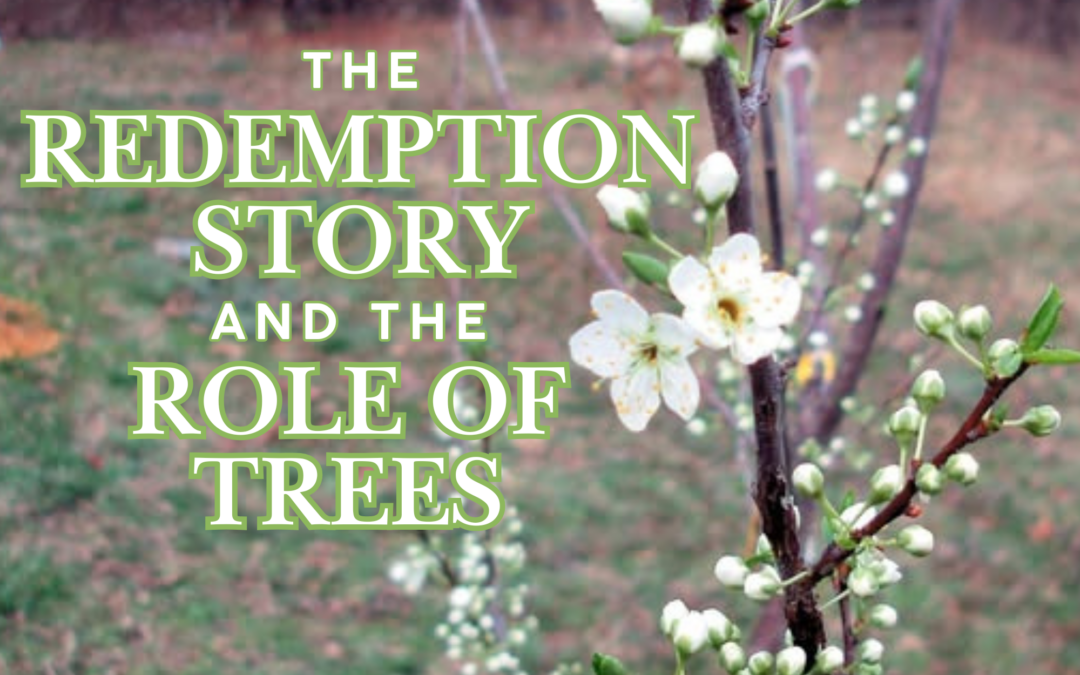
I love a little Auburn tree! It is the AU Rosa Plum tree, and it was developed by Auburn to have characteristics like the wild plums that grew prolifically when I was a child. The fruit reminds me of the wild plums I ate from my grandparents’ farm. Even though I purchased two, one of them did not survive last winter. I have treated these trees as treasured possessions because of how expensive they were, hoping they would thrive in Spring Valley’s climate. Despite regular watering, shielding, and checking for pests, our fruit trees seldom endure. I pray the Good Lord allows this one to survive, and I hope there will be wild plum trees in Heaven.
Trees are symbolic of so much of our spirituality. Being deeply rooted in God. Anchored by His love, we sway in the winds of change and storms of life. A favorite verse is found in Ephesians 3:17
”Then Christ will make His home in your hearts as you trust in Him, your roots will grow down into God’s love and keep you strong,” (NLT)
I want to get “in the dirt” and “dig” into the symbolism of trees in the Bible.
Other than God and people, trees are the most mentioned living thing in the Bible. Trees appear at nearly every major turning point in the entire Bible. From the first garden to the last river, from the first sin to the final healing, a tree is there.
God’s Profound Love for Trees
God created trees not only to nourish our bodies but also to delight our eyes. This intentional design demonstrates that God values trees deeply. Throughout the Bible, trees play a significant role—from the first trees in the Garden of Eden to the Cross, where Jesus gave Himself as a sacrifice. Many stories further highlight their importance, such as Zacchaeus climbing a tree to see Jesus, and the mustard seed representing the growth of faith. God’s appreciation for trees is so profound that the Bible tells us His throne faces a tree, emphasizing their continued spiritual significance.
Revelation 22:1-3 states,
“Then the angel showed me the river of the water of life, as clear as crystal flowing from the throne of God and the Lamb down the middle of the great street of the city. On each side of the river stood the tree of life, bearing twelve crops of fruit, yielding its fruit every month. And the leaves of the trees are for the healing of the nations.” (NIV)
Trees and Humanity: Divine Parallelism in Genesis
Creation and Connection
In Genesis 1, God creates trees on the third day and forms man, Adam, on the sixth day. Many Biblical commentaries identify this timing as a form of parallelism, drawing a deliberate connection between the two acts of creation.
Shared Origins and Purpose
Both trees and humans are described as coming from the ground (ha-adamah). They are each destined to be fruitful, carrying life and seed within themselves. The biblical text suggests that trees and people are meant to be understood together, linked in both origin and purpose. Adam, in Genesis 2:15, was specifically instructed to dress and keep the trees, further emphasizing this relationship.
Symbolism Throughout Scripture
Across both the Old and New Testaments, the Bible references approximately thirty-six distinct species of trees and woody plants, with over 250 verses mentioning trees. Fifty-six verses draw a comparison between knowing a tree by its fruit and identifying the fruit produced by humans. People are recognized by the fruit they bear; when we produce kindness, joy, love, and patience, others see the good fruit in our lives.
Which Biblical author mentions trees the most frequently? The Prophet Isaiah. Which Bible verse lists the most species of trees? Isaiah 41:19 states:
“I will put in the desert the cedar and the acacia, the myrtle, and the olive. I will set junipers in the wasteland, the fir, and the cypress together.” (NIV)
Trees are often used in the Bible to represent humanity in various ways. Thorns and thistles are symbolic of sinful humanity, while evergreen trees represent the upright. Fig trees represent Israel, and Oaks represent righteousness in man.
Trees of Passion Week
Several trees are symbolically connected to Passion Week, each carrying unique significance. As Jesus entered Jerusalem, palm tree fronds were spread along the road, marking His arrival. Palm fronds were associated with victory, royalty, and the recognition of Jesus as King and Messiah. This gesture honored Jesus as a triumphant leader and symbolized His victory over death as a humble and peaceful ruler.
On Monday of Passion Week, Jesus cursed the fig tree, as recorded in Mark 11. This was the only curse Jesus pronounced during His earthly ministry. On the same day, He cleansed the Temple of corrupt practices. The fig tree, though full of leaves, bore no fruit, representing the fruitless and hypocritical religious system of Israel. Jesus’ actions with the fig tree served as a warning of judgment and destruction for those who lacked genuine spiritual fruit.
Throughout Passion Week, the olive tree is a powerful symbol representing peace, suffering, and Christ’s sacrifice. In the Garden of Gethsemane, Jesus experienced intense anguish, being “pressed” under the burden of human sin. This mirrors the process in which olives are pressed to produce oil, capturing the depth of Jesus’ suffering. The olive tree’s resilience is also significant, reflecting eternal life, endurance, and the hope for reconciliation with God. Jesus was pressed by the weight of sin and the punishment he would soon bear for humanity.
The Cross: From Curse to Life
The crucifixion is often referred to as a “tree” (xylon) rather than a “cross” (stauros) by both Peter and Paul, alluding to Deuteronomy 21:23. From a Jewish viewpoint, this emphasizes Jesus accepting the curse that originated in Eden—where humanity first fell because of a tree—and redeeming it on another tree. This creates a theological symmetry in the narrative of redemption. The blood of Jesus transforms the dead wood of the Roman instrument of torture into a symbol of everlasting Life: the Tree of Life. The Cross, therefore, becomes a tree, cut down by human sin, but restored through Christ’s sacrifice.
The Crucial Role of Trees in the Resurrection
Without the existence of trees, the resurrection would not have taken place. The significance of trees is woven into the very fabric of the Easter celebration, as they form the backdrop for the Good News that is proclaimed on Easter morning. From the opening chapters of the Bible to its climactic moments and ultimate conclusion in Heaven, trees are consistently present as powerful symbols and meaningful connections throughout God’s story.
Reflecting on Trees During Passion Week
As you reflect on the events of Passion week, take time to observe trees both in the pages of Scripture and in the world around you. Trees are uniquely special, framing God’s redemptive plan and reminding us of His deep love for His people and His creation. During moments of refreshment and reflection, consider the immense love our Heavenly Father has shown. Give thanks to Jesus for enduring the cross—referred to as the “Old Rugged Cross”—and praise Him for achieving His purpose as the sacrificial Lamb. Through His blood, He has made eternal life in Heaven possible for all who believe.
Rebekah Marsh
Lean into Jesus Ministries
#rebekahmarshblogs